
Free resource · 6 minute read
3 Client Funnels I'd Build for a Service Business Right Now
Find the one that matches where your business is stuck, see exactly what I'd build, and what it's designed to change.
No pitch deck. You leave with a one-page plan of the funnel your business actually needs.
You don't need every funnel on the internet.
You need the right setup for the problem you actually have.
Maybe you need more leads. Maybe people are paying attention but not booking. Maybe you want a lower-cost way to turn strangers into buyers before asking them to invest thousands.
Here are three setups I'd consider first.
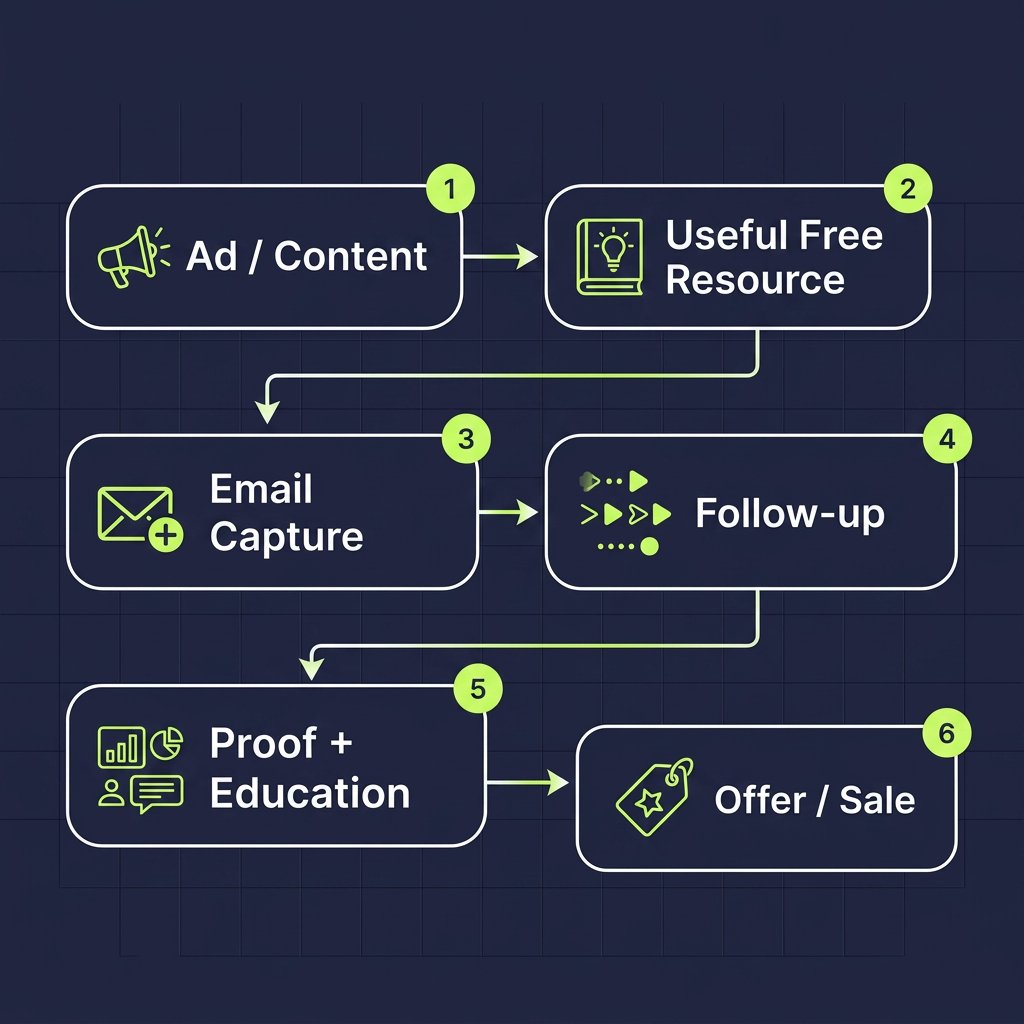
The Lead Generator
You need this if people simply aren't entering your world consistently.
This probably sounds familiar
You're good at what you do, but most new business still comes from referrals, networking, manually reaching out, or whatever you happened to post that week.
Some weeks you get three inquiries. Then nothing for two weeks.
When business gets quiet, your immediate reaction is: “Shit. I need to start marketing again.”
Here's what I'd build
- 1Ad / content
- 2Useful free resource
- 3Email capture
- 4Follow-up
- 5Proof + education
- 6Offer
What changes
Instead of waiting for someone to be ready to hire you before they enter your world, you're giving the right person an easy first step.
Now you have people raising their hands before they're ready to buy.
And because you captured their information, you don't lose them just because Tuesday wasn't the day they were ready to spend $2,000.
Life after this funnel
Post → hope → wait → panic → post again
New leads → follow-up → warmer audience → opportunities to sell
Your first marketing question stops being “What the hell should I post today?” and becomes “How many qualified people entered the system this week?”
What I'd measure
Cost per lead → email engagement → offer clicks → inquiries → sales
Not followers. Not likes. Not whether Tuesday's Reel made the algorithm happy.
Best for
Consultants, agencies, bookkeepers, coaches, fractional service providers and other businesses with a longer buying cycle.
Especially good if not enough people know you exist yet.
The Booked-Call Funnel
You need this if people are interested… but not enough of them are becoming sales conversations.
This probably sounds familiar
Maybe you're getting website traffic. People engage with your content. You get inquiries. You know there's interest. But booked calls still feel frustratingly inconsistent.
Or you're sending cold traffic directly to your calendar and expecting a 30-minute sales call to explain the problem, establish your expertise, build trust, answer objections and close.
That's asking a lot from one Zoom call.
Here's what I'd build
- 1Ad
- 2Landing page
- 3Short VSL
- 4Email follow-up
- 5Retargeting
- 6Booked call
What changes
The sales call stops being someone's introduction to you.
Before they ever get on your calendar, they've had a chance to understand the problem, hear how you approach it, see proof, and decide whether they actually want help.
You're not trying to convince every lead to book. You're giving the right leads enough information to want the conversation.
Life after this funnel
Cold lead → calendar → “So… what exactly do you do?”
Cold lead → educated lead → trust → booked call → real sales conversation
Your calendar isn't necessarily overflowing with random calls. The calls you do get have had more context before they arrive.

Real-world example · Case study
Bookkeeping service
- 186
- leads in 30 days
- 21
- booked calls
- 7
- new clients
- $18,900
- in new client revenue
The interesting number isn't 186. It's what happened between the lead and the sale.
The funnel gave people time to understand the bookkeeping problem, see why fixing it mattered, and learn about the service before they ever got on the phone.
Client case study. Results aren't guaranteed and will vary by business, offer, traffic and execution.
Best for
Higher-ticket services sold through conversations.
Especially if you're thinking: “People seem interested. Why aren't enough of them actually booking?”
The Buyer Funnel
You need this if asking a stranger to jump straight into your main service is too big of an ask.
This probably sounds familiar
Say your core service costs $2,000, $5,000 or more.
Someone sees one ad from you. They've known you for approximately 14 seconds. And your marketing says: BOOK A CALL!
That's a pretty big first date.
Instead, I'd consider giving them a smaller problem you can solve first.
Here's what I'd build
- 1Ad
- 2$19–$49 offer
- 3Checkout
- 4Delivery
- 5Buyer follow-up
- 6Core service
What changes
You're no longer dividing your audience into “bought my expensive service” and “didn't buy anything.” You create a middle.
Someone can spend $29, get a result, experience the way you think, and become a customer before you're asking them to make a much larger decision.
That changes the relationship.
Life after this funnel
Instead of paying for every click and hoping some tiny percentage eventually books, your front-end offer can help recover some of the cost of acquiring customers while identifying people willing to actually pull out their credit card.
Now your higher-ticket offer isn't always being presented to complete strangers. It's also being presented to existing buyers.
What I'd measure
Cost per purchase → average order value → buyer-to-core-offer conversion → customer acquisition cost → revenue
Because a $29 sale by itself isn't the point. What that buyer does next is.
Best for
Businesses with a clearly defined core service and a smaller problem that can genuinely be solved separately: templates, audits, mini-trainings, workshops, calculators, toolkits and small implementation products.
I would not start here just because selling a $27 product sounds fun. If the small offer attracts people who would never buy your actual service, you've built yourself a completely separate low-ticket business. Congratulations on your new job. 😂
Okay, but which one do I need?
“Not enough people are finding me.”
The Lead Generator
Build a larger pool of qualified people you can continue marketing to.
“People know about me, but booked calls are inconsistent.”
The Booked-Call Funnel
Give people more context, trust and follow-up before asking them to talk.
“My main offer is a big first purchase.”
The Buyer Funnel
Give the right audience a smaller way to become a customer first.
Still not sure which one fits you?
That's exactly what the audit is for. Send me your offer and where things feel stuck, and I'll map the funnel I'd build first — plus what to measure.
The part the diagrams don't show
A funnel isn't a client acquisition system. It's one part of one.
You can build the prettiest VSL funnel on earth, but if nobody sees it, nothing happens.
You can generate 500 leads, but if nobody follows up with them, you've built a very expensive email list.
You can sell a $29 product all day, but if those buyers never move toward your actual service, you've accidentally changed business models.
The funnel has to sit inside something bigger:
That's the boring part. It's also the part that makes the difference between occasionally getting clients from your marketing and having something you can actually rely on.
- 1Get found
- 2Capture interest
- 3Build trust
- 4Follow up
- 5Convert
- 6Bring people back
- 7Measure + improve
Want to see how all of that fits together?
I break down the entire Client Engine in 12 minutes.
No magic funnel. No “three posts that made me $47K.” No new tactic you have to remember to do every Tuesday.
Just the system I'd want running behind an online service business if consistent clients were the goal.
Before you book
Questions people ask first
Do I need paid ads?
No. The maps can work with content, referrals, partnerships, outreach or paid traffic. The funnel is the structure that turns attention into leads — where the attention comes from is a separate decision, and plenty of businesses start with the channels that cost them time instead of money.
That said, I'd recommend paid traffic once the funnel itself is doing its job. Content, referrals and outreach all scale slowly and depend on you showing up every week. Ads let you turn the volume up on demand, see whether an offer lands in days instead of months, and push enough people through the funnel to tell what's actually broken.
My usual order is: build the funnel, prove it converts the traffic you already have, then add spend. Putting money in front of a funnel that leaks just makes the leak more expensive.
Do I need all three funnels?
No. Start with the funnel that fixes the biggest gap in your current client path.
If hardly anyone knows you exist, a booked-call funnel has nothing to work on — you need the Lead Generator first. If people already come to you but nothing lands on your calendar, a bigger email list won't fix that; the Booked-Call funnel will. And if your main offer is a big first purchase that people keep stalling on, that's the Buyer funnel's job.
Building all three at once is usually a way of avoiding picking one. One funnel running properly — follow-up and measurement attached — beats three half-built ones. Add the next one once the first is doing its job. Most businesses get two running before the third one actually makes sense.
Will this work with my existing website?
Usually. A funnel can sit alongside your current website without requiring a complete rebuild.
A funnel isn't your homepage — it's a focused page or short sequence with one job: move one type of person toward one next step. It can live on a subpage of the site you already have, on a landing page tool, or inside whatever you're using today, while your main site stays put for people who want to browse.
What you generally do need is a way to capture emails, something that delivers the free resource, and a place to run follow-up. If your site can't do that today, we bolt those pieces on rather than rebuilding the whole thing — and the audit will tell you which parts of what you already have are worth keeping.
How long until I see anything happen?
Faster than you'd expect for leads, slower for revenue.
With traffic going in, a Lead Generator can capture its first emails within days. What that doesn't tell you yet is whether they're the right people — that read comes from follow-up engagement and inquiries, usually over two to four weeks. A booked-call funnel shows up in your calendar over 30 to 60 days, because people move through it at their own pace. A buyer funnel gives the quickest honest signal: either strangers pay $29 or they don't.
Anyone promising a fully predictable client pipeline in week one is selling you traffic, not a system.
What do I need to prepare for the free audit?
Nothing formal. Bring your website or booking link, what you're actually selling, and one sentence on where it feels stuck — "not enough leads", "calls don't show up", "nobody buys".
I'll look at it before the call, map the funnel I'd build first, and send you a one-page plan with what I'd measure in the first 30 days. No deck, no pitch, and the plan is yours whether we work together or not.
Still have a question that isn't here? Bring it to the audit →
Free · 20 minutes · No pitch
Get the funnel plan for your business
On a free funnel audit I'll look at your offer, traffic and follow-up, tell you which of these three funnels I'd build first, and what I'd measure in the first 30 days. You keep the plan whether we work together or not.
- The one funnel I'd build first — and the two I'd skip for now
- The gap that's actually costing you booked calls
- A simple 30-day measurement plan (leads → calls → clients)
Limited spots each week — I only take audits I can actually prepare for.